
Alumni Update: Viola
5th February 26
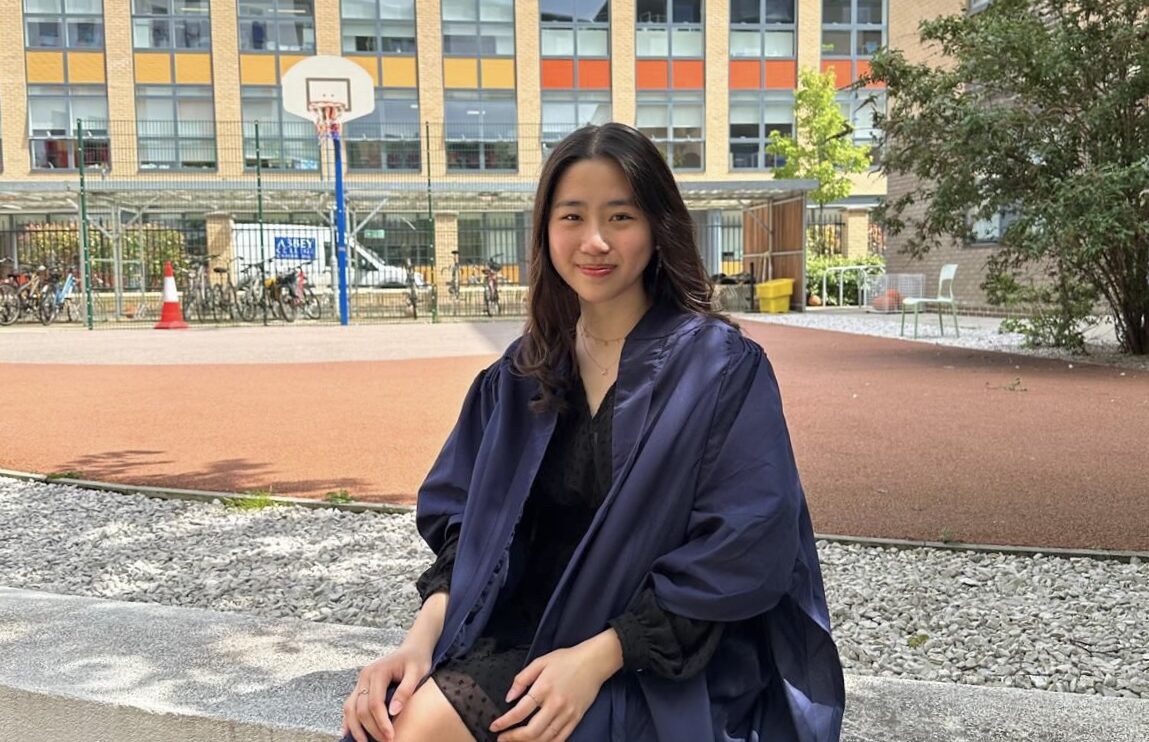
From Abbey College Cambridge to Imperial Innovation
For Abbey College Cambridge alumna Viola, the journey from A Levels to the cutting edge of biomedical science has been defined by curiosity, independence, and the confidence to ask big questions.
Now entering her second year studying Medical Biosciences at Imperial College London, Viola reflects on her first year as a transformative leap – one that challenged her to grow far beyond the structure of school learning. “University requires you to become an independent thinker,” Viola shares. “The guidance is less prescribed, and you have to take initiative and form your own perspective.”
Her first year built a deep foundation in biomedical theory and laboratory practice, but more importantly, it taught her how to navigate the freedom and responsibility of higher education – a skill that has already defined her early professional journey.
Stepping Into the World of Medical Innovation
Alongside her academic studies, Viola has gained impressive hands‑on experience in the biomedical field. Her roles have ranged from Laboratory Assistant to her current position as a Clinical Services Management Trainee and Clinical Trial Assistant, contributing to the development of a promising drug targeting HER2-negative breast cancer.
The contrast between academic and professional environments has been eye-opening: “Academia teaches you to find answers,” she explains, “but the professional world expects you to define the questions. You often have to create solutions without a clear roadmap.”
Through clinical trial work, Viola has come to appreciate the real-world impact of precision, communication, and responsibility. Every detail matters when patient outcomes are involved, and the shift from guided learning to autonomous contribution has accelerated her personal and professional growth.
A Future Driven by Passion for Discovery
When Viola first imagined a career in research, she expected it might feel repetitive or isolating. But her experiences at Imperial have rewritten that assumption. “I realised that genuine passion for a subject outweighs the nature of any task,” she says. “The idea of dedicating myself to a research topic I find truly compelling is exciting.”
This shift has inspired Viola to envision a future as a scientific researcher, contributing meaningfully to biomedical discovery. Her growing academic interests and early professional insight have solidified her ambition to play a role in shaping the future of medical science.
How Abbey College Cambridge Helped Shape Her Path
Looking back, Viola credits Abbey College Cambridge with laying the groundwork for her success at university and beyond. She recalls the exceptional teaching, especially in Year 13, when lessons often extended beyond the A Level syllabus and sparked her curiosity for deeper scientific understanding.
“I really appreciated the teachers introducing concepts outside the curriculum,” she says. “It broadened my horizons before university and made my future studies much more approachable.”
Equally impactful were the conversations she had with teachers – many with professional experiences and academic achievements she admired. Their advice and insight prepared her not just for university, but for the realities of life after Abbey.
From Abbey to Imperial – and Beyond
Viola’s story is one of curiosity, independence, and the courage to redefine her own expectations. From mastering foundational skills at Abbey College Cambridge to navigating the intellectual freedom of Imperial College London and contributing to meaningful clinical research, she is already carving out an inspiring path in biomedical science.
As she continues her studies and explores the world of research, we’re excited to see how Viola will shape the future of scientific discovery.